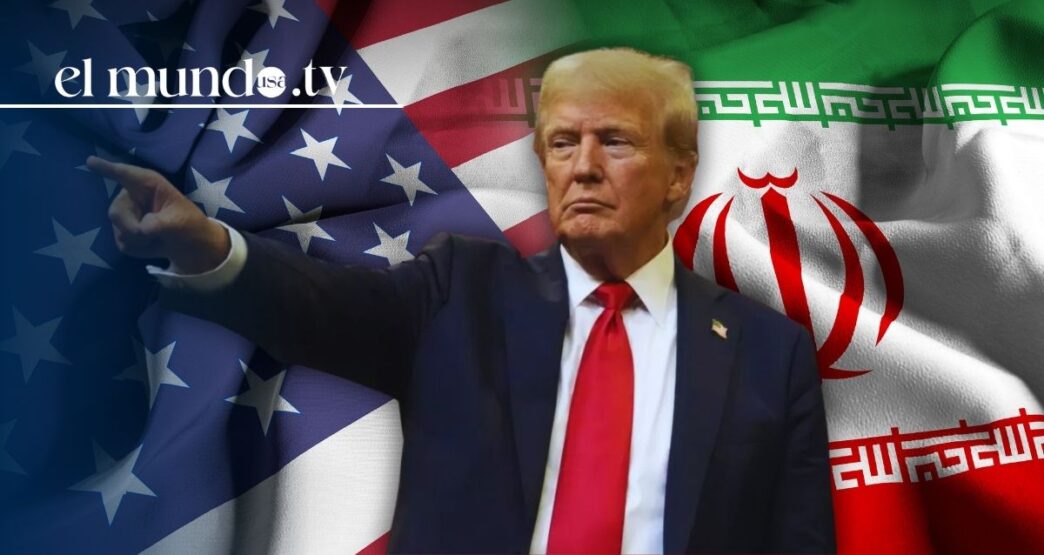
On Wednesday, January 28, US President Donald Trump heightened international tensions by confirming that a large-scale naval fleet, larger than the one he sent to Venezuela to capture Nicolás Maduro, is heading toward Iran, warning that he could carry out a military attack “much worse” than the one in June 2025 if no agreement is reached on Iran’s nuclear program.
In a message posted on social media, the president assured that it is a fleet superior to the one previously sent to Venezuela, and that it is headed by the aircraft carrier USS Abraham Lincoln, one of the most powerful in the U.S. Navy.
“A huge armada is heading to Iran. It advances with speed, great power, enthusiasm, and determination”, Trump wrote.
Follow our accounts on Facebook and Instagram to stay up to date with the latest news.
The United States increases military pressure on Iran
Trump stated that the fleet is ready to act swiftly and forcefully, and made it clear that Washington does not rule out the use of force if Tehran refuses to negotiate.
“Just as happened in Venezuela, this fleet is prepared to carry out its mission swiftly and violently, if necessary”, he warned.
The president insisted that his goal is to force Iran to negotiate a nuclear agreement without atomic weapons, although he stressed that the window for diplomacy is closing.
“Time is running out. Iran must sit down at the table and reach a fair and equitable agreement”, he said.
Trump recalls the 2025 bombings of Iranian nuclear facilities
The U.S. president made direct reference to the military operation “Night Hammer”, carried out in June 2025, when the United States bombed three Iranian nuclear facilities in the context of the Israeli offensive against the country.
The military escalation left more than 1,100 dead and prompted a response from Tehran with the launch of hundreds of missiles and drones against Israeli territory, marking one of the most serious episodes of the conflict in the Middle East.
“They didn’t accept a deal, and Operation Nite Hammer arrived. The next attack will be much worse. Don’t let it happen again”, Trump declared.
Read more: China promises support to Cuba in the face of U.S. threats and demands an end to the blockade
Iran rejects negotiations under military threats
Following the U.S. president’s statements, Iranian Foreign Minister Abbas Araqchi denied that there have been any recent contacts with U.S. Special Envoy Steve Witkoff or that Tehran has requested a resumption of negotiations.
“There have been no contacts in recent days, and we have not requested negotiations”, he said.
Araqchi maintained that Iran’s position remains firm and rejected diplomacy based on military threats, arguing that this approach cannot lead to genuine agreements.
The nuclear agreement with Iran, an unresolved conflict
Iran has repeatedly reiterated that it will not initiate new talks with the United States without security guaranties, especially after Donald Trump withdrew from the 2015 nuclear agreement during his first term in 2018.
Since then, relations between the United States and Iran have been characterized by economic sanctions, military warnings, and recurring episodes of high tension that keep the international community on alert.